
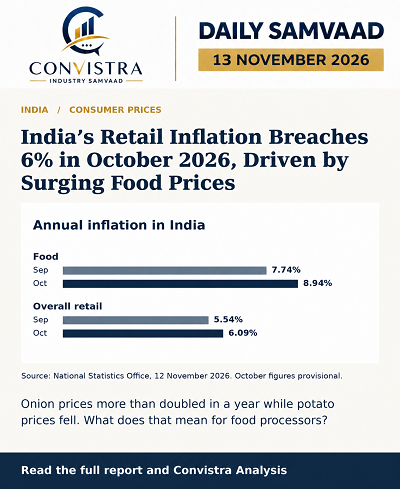
New Delhi: India’s retail inflation has crossed the 6% mark, driven largely by a sharp increase in food prices. According to the latest provisional data released by the Ministry of Statistics and Programme Implementation (MoSPI), retail inflation based on the Consumer Price Index (CPI) rose to 6.09% in October 2026. This marks an acceleration from the 5.54% retail inflation recorded in September 2026. The latest figures indicate that inflation has breached the Reserve Bank of India’s (RBI) upper tolerance ceiling of 6%.
Food Inflation Nears 9%
The surge in overall inflation was heavily influenced by rising costs in the food basket.
- Consumer Food Price Index (CFPI): Food inflation reached 8.94% in October 2026, a significant increase from 7.74% in September.
- Rural vs. Urban Divide: The data reveals that inflation is hitting rural areas harder. Rural retail inflation stood at 6.63%, compared to urban inflation at 5.41%. Similarly, rural food inflation was higher at 9.09%, while urban food inflation was 8.68%.
Onion and Garlic Prices Skyrocket
A closer look at individual commodities reveals extreme price volatility in kitchen staples. The top five items driving inflation at the all-India combined level include:
- Onion: Recorded a staggering 116.22% inflation rate in October, up from 108.13% in September.
- Garlic: Prices surged by 60.74% year-on-year.
- Silver Jewellery: Experienced an inflation rate of 52.39%.
- Ginger and Lemon: Recorded inflation rates of 48.32% and 47.30%, respectively.
Conversely, some vegetables offered relief to consumers. The data highlighted the top items with the lowest inflation (deflation):
- Potato: Prices dropped by 14.24%.
- Cauliflower: Witnessed a decline of 10.57%.
- Coconut: Prices decreased by 5.60%.
- Brinjal and Cabbage: Saw prices fall by 3.34% and 1.92%, respectively.
Data Collection and Base Year
The MoSPI calculates the current CPI using a base year of 2024 (2024=100). The real-time price data for this report was gathered by the field staff of the National Statistical Office (NSO) through personal visits to 1,407 urban markets and 1,465 villages across all States and Union Territories on a weekly roster.